|
OBRA e-z’s market consists of the
approximately 18,000
long-term care providers in the United States.
OBRA e-z expects to capture about 6%
(or 1,025 customers) of that market by the end
of Year 5.
Our market segmentation scheme
divides the market into
three groups: long-term
care
providers who use software produced by the top three competitors,
long-term care
providers who use middle-market software, and long-term care providers
who use
lower market software, or none at all.
Our
estimates are that each segment represents about 1/3 of the market.
OBRA e-z will target all three market
segments with
initial focus on the lower- and middle-market software users.
OBRA e-z’s Enterprise Software
Solution will add some
functionality and significant ease of use to customers in this market.
We have recently converted numerous customers
from competitive products
to OBRA e-z, and our experience has been that MDS coordinators familiar
with
OBRA e-z who change employers usually recommend to their new employers
to change
to OBRA e-z. Time
is a critical
commodity in the long-term provider business, and OBRA e-z saves MDS
coordinators a considerable amount of time.
We believe our price will be very
attractive to
long-term providers who are paying from $1,000 to $1,500 per month in
maintenance fees. That
segment will
be able to recover their licensing fee in just a few months, and we
believe our
Windows-driven product will be far more user friendly than those
products
currently on the market.
The market requires a highly
functional product that is
cost effective and easy to use. OBRA
e-z will provide that. The
market
needs help when the market wants help, and OBRA e-z’s 24/7/365 help
desk will
provide that.
According
to the U.S. Census Bureau, America's population aged 65 or older
grew by 82 percent between 1965 and 1995. Between 1980 and 1995, this
same
population grew by 28 percent to a historical high of 33.5 million
people.
Currently, one in eight Americans is 65 years of age or older. And
while less
than 25 percent of the population is younger than age 15, another 57
percent is
aged 30 or older. Clearly, the proportion of older citizens is growing
and will
continue to do so with the aging of the baby boomers.
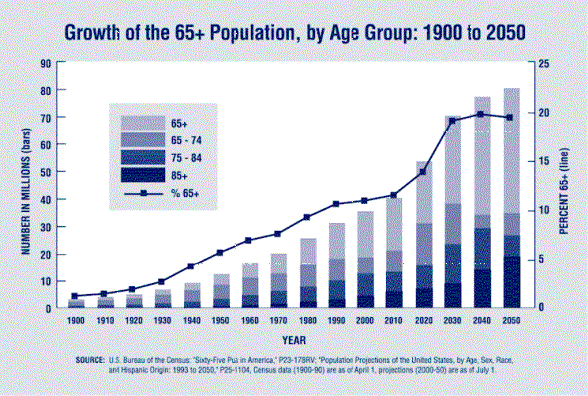
The
75 million people born in the United States between 1946 and
1964 constitute the baby boom generation. In 1994, baby boomers
represented
nearly one-third of the U.S. population. Within the next 13 to 34
years, these
people will enter the 65-years-and-older age category. As the baby
boomers begin
to age, the United States will see an unparalleled increase in the
absolute
number of elderly persons. While one in eight Americans was 65 years of
age or
older in 1994, in a little more than 30 years, about one in five is
expected to
be in this age group.
The U.S.
Administration on Aging (AoA) is encouraging planners and policy
makers to prepare now for the aging of the baby boomers so that the
nation is
prepared to meet the challenges that will ensue as this unprecedented
large
generation begins reaching age 65.
OBRA e-z will not pursue a niche
strategy to the market.
We view everyone in the long-term care
provider business as potential
customers. Our Enterprise
Software Solution will serve the needs of all long-term care
providers, both
small and large. It’s
a
total solution, cost effective, and its user-friendly features will
significantly improve productivity in any environment.
We will approach the market through
internet, print
and direct mail advertising, and direct contact.
We are currently negotiating with nine of the
most popular
health care sites on the internet to include an advertising link to
obraez.com:
-
amda.com
-
nadona.org
-
achca.org
-
ana.org
-
ascp.com
-
cna-network.org
-
healthinaging.org
-
ngna.org,
and
-
snalf.com
These sites draw a lot of traffic
from individuals in
the long-term care provider industry.
We will also advertise in the Long
Term Provider
professional magazine. Although
this magazine has a subscription price, complimentary subscriptions are
provided
to professionals in the long-term provider industry.
We will target long-term care
providers with direct
mail advertising and follow up with sales calls from our own marketing
people as
well as independent resellers interested in selling our product.
|